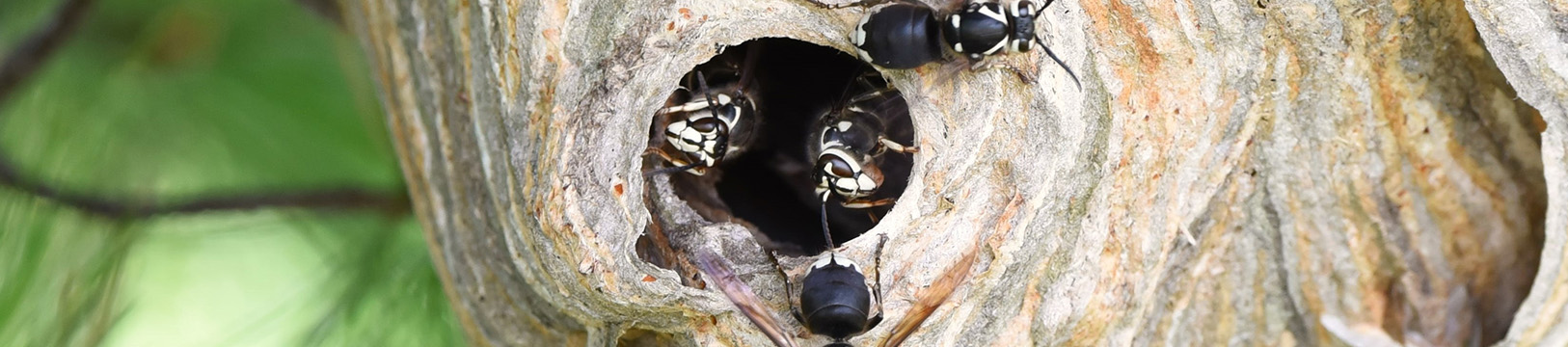

Bald-faced hornets are large black-and-white wasps known for building aerial paper nests and aggressively defending their colonies. Homeowners most often encounter them around trees, rooflines, sheds, and other elevated areas during summer and early fall. Because they can sting repeatedly and defend their nests aggressively, bald-faced hornets are one of the most concerning stinging insects we encounter in Oklahoma and North Texas.
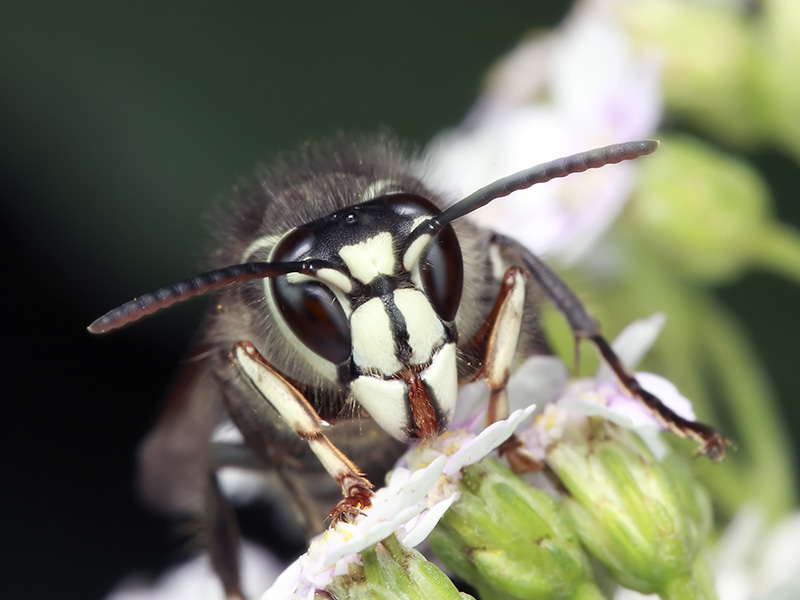
Bald-faced hornets are large, black-and-white stinging insects that belong to the yellow jacket family. Despite their name, they are not true hornets. They get the name "bald-faced" from the distinctive white or ivory markings on their face.
Adults typically measure about three-quarters of an inch long, making them noticeably larger than most yellow jackets. They have a stocky body and black coloring with distinctive white markings on their face, thorax, and abdomen. Like other wasps, they have six legs, two antennae, and a pair of wings.
Bald-faced hornets are most active from June through September, when colonies are growing rapidly and worker populations are at their highest. Homeowners are most likely to notice large nests and increased hornet activity during late summer, when colonies reach their peak size.
Adult bald-faced hornets feed primarily on nectar, fruit juices, and tree sap. They are also skilled predators that hunt other insects, including flies, yellow jackets, and caterpillars. They chew their prey into a paste and feed it to their developing larvae back in the nest.
Bald-faced hornets are usually attracted by food sources, water, and suitable nesting locations. Flowering plants, fruit trees, outdoor trash areas, and abundant insect activity can all attract foraging hornets. If a colony builds a nest nearby, you may suddenly start noticing increased activity around your home, deck, or yard.
Bald-faced hornets are among the most aggressive stinging insects when it comes to defending their nests. They are territorial and will attack in large numbers if they sense a threat near the colony. Workers can detect vibrations and movement from several feet away, and they do not hesitate to pursue perceived intruders.
Away from the nest, bald-faced hornets are generally less confrontational. However, their defensive behavior makes it especially important to keep your distance if you spot a nest on or near your property.
Yes. Like other wasps, bald-faced hornets have smooth stingers, which means they can sting repeatedly without losing them. A single hornet can deliver multiple stings during a single encounter.
Bald-faced hornets can also spray venom from their stinger toward the eyes and face of anyone who gets too close to their nest. This venom can cause temporary eye irritation and pain.
Bald-faced hornet stings cause immediate pain, swelling, and redness at the sting site. For most people, the discomfort fades within a few hours to a couple of days. However, because these hornets often sting in groups when defending their nest, receiving multiple stings at once increases the severity of the reaction.
If you are allergic to stinging insect venom, a bald-faced hornet sting can trigger serious symptoms, including difficulty breathing, hives, and anaphylaxis. Seek medical attention immediately if you experience a severe reaction.
Bald-faced hornets build large, enclosed, paper-like nests. These nests are typically football-shaped or pear-shaped and can grow larger than a basketball by late summer. The hornets construct them by chewing wood fibers and mixing them with saliva to create a papery material.
Bald-faced hornets almost always build their nests in elevated locations. Common nesting sites include tree branches, large shrubs, building overhangs, eaves, utility poles, and the sides of structures.
At The Pied Piper, we commonly find bald-faced hornet nests attached to tree branches, under rooflines, around sheds, and on outbuildings throughout Oklahoma and North Texas. These elevated locations provide protection from predators and weather while giving the colony easy access to surrounding food sources.
The most obvious sign is the nest itself—a large, gray, papery structure hanging from a tree, shrub, or structure. Early in the season, nests may be small and easy to overlook. By late summer, they can grow quite large and become more visible as leaves begin to thin out.
You may also notice a steady stream of hornets flying to and from a specific spot on your property. If you see multiple bald-faced hornets in the same area repeatedly, a nest is likely nearby.
Do not attempt to remove a bald-faced hornet nest on your own. These hornets are extremely aggressive when their nest is disturbed, and a colony can contain several hundred workers by late summer. Approaching or knocking down a nest can trigger a swarm.
If you discover a nest on or near your property, keep people and pets away from the area and contact The Pied Piper right away. Our team has the training and equipment to handle bald-faced hornet nests and eliminate the colony.
Although bald-faced hornets technically belong to the yellow jacket family, there are several differences between them and the yellow jackets most people recognize.
Bald-faced hornets are larger, with black-and-white coloring instead of the familiar black-and-yellow pattern. They build large, enclosed aerial nests, while many yellow jacket species nest underground or in wall voids. Bald-faced hornets also tend to be more aggressive near their nests and have the ability to spray venom, which other yellow jackets do not.
Contact The Pied Piper if you notice bald-faced hornets flying around your property or discover a nest.
Our highly trained technicians have the expertise and equipment to eliminate bald-faced hornet colonies and keep your family protected.
For ongoing protection against bald-faced hornets and other stinging insects, we recommend signing up for our Piper Elite Plan, a year-round home pest control plan.
Contact The Pied Piper for more information, and let us help you keep your property comfortable and pest-free.
While you cannot completely eliminate the chance of bald-faced hornets nesting on your property, you can reduce the conditions that attract them. Follow these tips to help keep bald-faced hornets away:

Pied Piper does a very thorough job. I own a local restaurant and they keep the place pest free. If any bugs break through, they are there in a heartbeat to take care of it.
Chuck K.
Eufaula, OK

Brad was excellent very professional and efficient! He went to the root of the problem and addressed it appropriately as needed. The service ladies you call for scheduling are also very polite and friendly . All around 10 on 10 ! Their products actually work too unlike others we’ve used in the past.
Lisa N.
Eufaula, OK

Always prompt to respond and very helpful when pest problems arise! They even came same day to set traps when I had a mouse and returned to remove the mouse after it was caught. Very pleased!
Hannah G.
Eufaula, OK


Helpful Tips & Info