
House centipedes are fast-moving indoor pests that often catch homeowners by surprise as they race across floors, walls, or bathroom surfaces. Their extremely long legs and quick movements make them easy to notice, even though their bodies are relatively small.
House centipedes feed on other insects, so if you’re seeing them indoors—especially more than once—it could be a sign there’s other pest activity nearby.
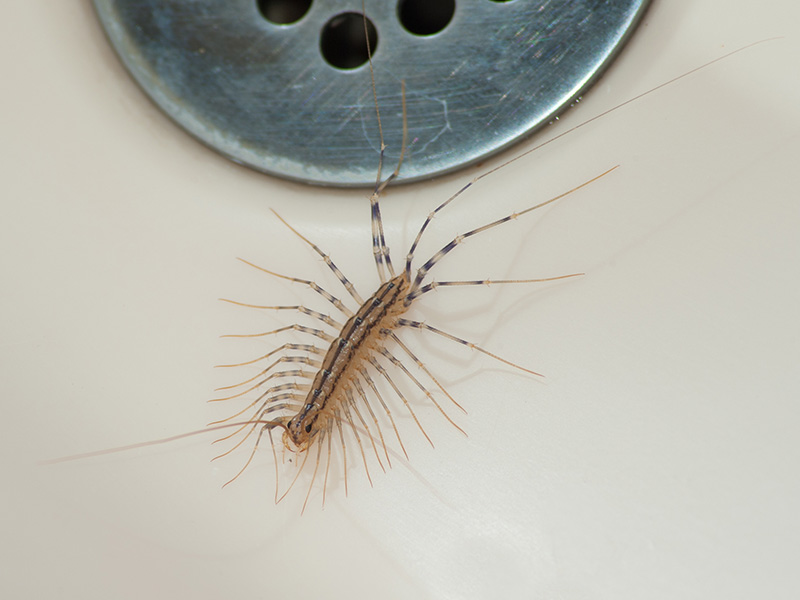
House centipedes are easy to recognize once you know what you’re looking at. Their bodies are usually only about 1 to 1½ inches long, but their extremely long legs make them appear much larger.
Adult house centipedes have 15 pairs of slender legs, along with long antennae. Their bodies are generally grayish-yellow with three darker stripes running lengthwise along the back, and their legs often have alternating light and dark bands.
Their long-legged appearance separates house centipedes from the heavier-bodied centipedes that also occur in Oklahoma and Texas. House centipedes are also exceptionally fast and may dart across a wall or floor when disturbed.
House centipedes can be found indoors year-round in Oklahoma and North Texas. Unlike many centipedes that primarily live outdoors, house centipedes can live and reproduce inside buildings where temperatures remain relatively stable.
Sightings may become more noticeable during the warmer months when insects and other arthropods are also more active around homes. However, finding a house centipede during winter does not necessarily mean it recently came in from outdoors.
House centipedes are predators. Instead of feeding on wood, fabrics, stored food, or other materials in a home, they hunt insects, spiders, and other small arthropods, including cockroaches, earwigs, and ants.
Their presence indoors can sometimes point to another pest problem. If house centipedes regularly find enough prey to remain in one area, other insects may be active nearby even if you haven’t seen them yet.
House centipedes look intimidating, but they are generally considered nuisance pests. They do not damage homes, furniture, or belongings, and they are not known to spread disease.
House centipedes use venom to subdue their prey and are capable of biting people, but bites are uncommon. Their first response when disturbed is usually to run for cover rather than defend themselves.
If you experience a concerning reaction after any suspected pest bite, contact your healthcare provider.
House centipedes are usually drawn to areas that provide shelter, moisture, and access to prey.
In Oklahoma and North Texas homes, that does not necessarily mean the entire house has a moisture problem. A localized damp area around plumbing, beneath a sink, in a crawl space, near a utility area, or in another protected location may provide favorable conditions for house centipedes and the insects they hunt.
House centipedes can also get inside through openings around:
An occasional house centipede may simply have wandered inside. Seeing them regularly is a stronger reason to investigate what is allowing them to remain there.
House centipedes prefer protected areas and usually stay hidden during the day before coming out to hunt at night.
Homeowners may find them:
They are also commonly noticed when one becomes trapped in a bathtub or sink or suddenly races across a floor or wall.
One house centipede does not necessarily mean you have a large population living inside your home. Repeated sightings, however, suggest that your property continues to provide something they need.
That could include localized moisture, protected hiding areas, easy access from outdoors, or other insects and arthropods providing a food supply.
Because house centipedes are predators, frequent sightings are worth looking at as part of the larger pest problem rather than simply focusing on the individual centipedes you see.
House centipedes and millipedes both have many legs, but they look and behave very differently.
House centipedes have flattened bodies with one pair of legs per body segment. Their legs are extremely long compared with their bodies, and they can move surprisingly fast. They are predators that hunt other small arthropods.
Millipedes have rounder, more cylindrical bodies with much shorter legs. They have two pairs of legs on most body segments, move more slowly, and primarily feed on decaying plant material.
If a many-legged pest races quickly across a bathroom wall or floor on long, delicate-looking legs, it is much more likely to be a house centipede.
Making your home less favorable to house centipedes and the pests they hunt can help reduce indoor activity.
Because house centipedes feed on other pests, reducing the insects they hunt can be an important part of making your home less attractive to them.
When you contact The Pied Piper for help getting rid of house centipedes, we will inspect your property and treat existing activity. But you do not have to wait for another pest problem to show up before calling again.
All of The Pied Piper’s residential pest control plans cover house centipedes and include ongoing preventive service. With regular exterior treatments, our technicians work to keep house centipedes and other common household pests under control year-round, helping reduce the chances of them moving indoors in the first place.
That ongoing protection is especially useful with house centipedes because several of the insects they prey on are also covered by our Piper Pro and Piper Elite plans. Instead of treating one centipede sighting at a time, a residential pest control plan gives your home broader protection against the pest activity that can support them.
If you’re seeing house centipedes now—or simply want year-round pest protection in place, The Pied Piper is here to help. Find the nearest branch or call (888) 605-1141 for assistance.

We’ve used Pied Piper Pest Control for over two years. We highly recommend them. Every technician is highly trained and very professional. We are out in the country and our young grandchildren visit frequently. We never worry about wasps, hornets, spiders, scorpions or mice thanks to the thorough and effective service we receive from Piper Pest Control. Their team answers all our questions and is consistently great at communicating with us. Thank you for your profession demeanor and great service!
Stacey H.
Eufaula, OK

My husband and I have been using Pied Piper for a year or two. We have had really good results with their services! I highly recommend them! Friendly efficient service!
Erin C.
Eufaula, OK

Always prompt to respond and very helpful when pest problems arise! They even came same day to set traps when I had a mouse and returned to remove the mouse after it was caught. Very pleased!
Hannah G.
Eufaula, OK


Helpful Tips & Info